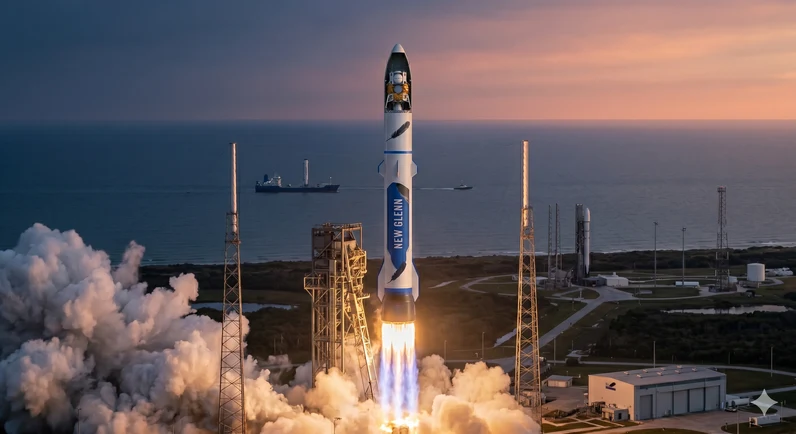
The aerospace landscape has shifted. As of April 2026, Blue Origin has transitioned from a secretive venture to a primary pillar of the global space infrastructure. The company has pivoted its strategy, trading the spotlight of suborbital tourism for the high-stakes arena of heavy-lift orbital logistics and NASA’s Artemis lunar missions.
1. New Glenn: The Heavy-Lift Powerhouse
After its inaugural flights in 2025, the New Glenn rocket has become a cornerstone of the orbital launch market. This 98-meter-tall behemoth is designed for mass-scale reusability, directly challenging the dominance of SpaceX’s Falcon Heavy and Starship.
- Mixed Success for NG-3: On April 19, 2026, Blue Origin launched its third New Glenn mission from LC-36. While a second-stage anomaly prevented the AST SpaceMobile BlueBird 7 satellite from reaching its final orbit, the mission achieved a massive secondary goal.
- Booster Recovery: The first-stage booster, nicknamed "Never Tell Me The Odds," successfully landed for the second time on the recovery ship Jacklyn, proving the viability of Blue Origin's reusable heavy-lift hardware.
- Payload Capacity: New Glenn remains a titan in the market, capable of carrying up to 13 metric tons to GTO and 45 metric tons to LEO, powered by seven BE-4 engines producing 19,600 kN of thrust.
2. The Great Lunar Pivot: Blue Moon
In a major strategic shift announced on January 30, 2026, Blue Origin has paused New Shepard space tourism flights for at least two years. This move redirects all engineering and financial resources toward accelerating the Blue Moon lander program.
- Artemis Partnership: As a winner of NASA’s Sustaining Lunar Development contract, Blue Origin is developing the Blue Moon Mark 2 (HLS) to carry four astronauts to the lunar surface for the Artemis V mission.
- Mark 1 Cargo Lander: Currently slated for its debut in late 2026, the robotic Mark 1 serves as an autonomous "base station," capable of delivering 3,000 kg of payload to support a sustained human presence.
- Blue Alchemist: The company continues to advance "regolith-to-solar" technology, aiming to manufacture solar cells directly from moon dust—a critical step for lunar industrialization.
3. Industrial Engine Production: The BE-4 Factory
Blue Origin’s role as an engine supplier has matured. The BE-4 engine—fueled by liquid methane (LNG) and liquid oxygen (LOX)—is now in high-rate production in Huntsville, Alabama.
- Dual-Use Tech: The BE-4 is the primary engine for both Blue Origin’s New Glenn and United Launch Alliance’s (ULA) Vulcan Centaur, successfully ending U.S. reliance on Russian-made RD-180 engines for national security.
- Reliability: Designed for 100 flights, the BE-4 utilizes hydrostatic bearings to increase service life, delivering 2,800 kN (640,000 lbf) of thrust at sea level.
4. Future Infrastructure: TeraWave and Blue Ring
Beyond launch and landing, Blue Origin is building the "connective tissue" of the space economy.
TeraWave
Introduced in early 2026, TeraWave is a satellite communications network designed to deliver symmetrical data speeds of up to 6 Tbps globally. With a planned constellation of over 5,000 satellites, it is set to begin deployment in late 2027 to provide high-throughput links for enterprise and government users.
Blue Ring
The Blue Ring platform serves as a multi-mission orbital tug. Its first mission, expected in mid-2026, will demonstrate Space Domain Awareness (SDA) in Geostationary Orbit (GEO) by hosting advanced sensors from partners like Scout Space and Optimum Technologies.