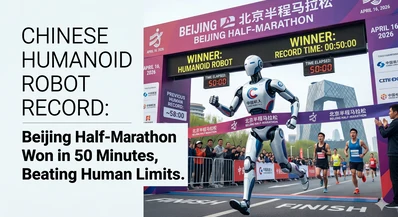
For years, the "uncanny valley" of robotics was defined by a clunky, unstable gait. We watched videos of robots falling over boxes or struggling with stairs. But on Sunday, April 19, 2026, that narrative was incinerated. During the Beijing International Half-Marathon, a fleet of humanoid robots didn't just participate—they dominated.
The winner, a prototype from the Chinese tech giant Honor, crossed the 21.09 km finish line in an staggering 50 minutes and 26 seconds. To put that in perspective, the current human world record for a half-marathon stands at 57:31. We are no longer talking about robots that can "mimic" human movement; we are talking about machines that have officially surpassed human biological limits in endurance and speed.
The Engineering Behind the 50:26 Sprint
How did a bipedal machine—traditionally prone to overheating and battery drain—maintain a sub-2:30 minute-per-kilometer pace for nearly an hour? The answer lies in two critical architectural breakthroughs: Active Liquid Cooling and Agentic Pathfinding.
1. The End of Thermal Throttling
Previous iterations of humanoid bots were limited by "thermal fatigue." Moving heavy metal limbs at high speeds generates massive heat in the joints and processors. Honor’s winning unit utilized a closed-loop liquid cooling system inspired by high-end gaming rigs, allowing the actuators to operate at peak torque without the risk of seizing.
2. "Fly Brain" Navigation
Following the "Fly Brain" neural mapping breakthrough we reported on earlier this week, these robots utilized a new form of on-device AI. Instead of relying on a distant server or a simplified GPS map, the bot used Simultaneous Localization and Mapping (SLAM) processed entirely on its internal NPU. It "felt" the road, adjusted for wind resistance, and optimized its stride in real-time with the instinctual logic of a living organism.
Why This Matters for the Indian Tech Ecosystem
While a robot winning a race makes for a great headline, the implications for the Indian market—particularly in logistics and industrial automation—are massive.
India’s delivery and warehouse sectors are currently at a crossroads of labor costs and efficiency. If a humanoid can navigate a complex outdoor environment (like the crowded streets used in the Beijing race) while maintaining high speeds and structural integrity, the "Last Mile" delivery problem is effectively solved. We are looking at a future where the "delivery boy" is replaced by a high-speed robotic courier that never tires, never needs a break, and can navigate stairs as easily as a human.
The Verdict: The Physical AI Era is Here
The Beijing half-marathon wasn't a sporting event; it was a stress test. It proved that the hardware has finally caught up to the software. We have the "brains" (LLMs and Neural Maps), and now we have the "bodies" (Liquid-cooled, high-torque humanoids) to match.
For the critics who said robots would always be "sluggish," the 50:26 clock has silenced the room. The question is no longer if robots will walk among us, but how we plan to share the road with them.