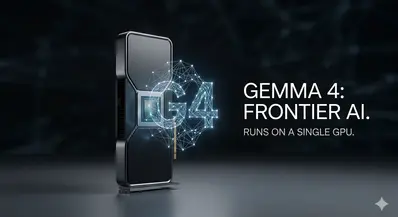
For a long time, there has been a clear dividing line in the world of artificial intelligence: if you wanted "frontier-level" performance—the kind of reasoning power found in GPT-4 or Claude 3—you had to rent a massive cluster of cloud-based H100s. Local, open-weight models were excellent for specific tasks, but they generally lacked the "cognitive overhead" required for complex, multi-step logic.
Google DeepMind just erased that line.
With the release of Gemma 4, the industry has hit a massive milestone. We are no longer talking about "compressed" or "distilled" versions of larger models that lose their edge. Gemma 4 represents a fundamental architectural shift that allows a model with state-of-the-art reasoning to run efficiently on a single, consumer-grade GPU.
Efficiency by Design, Not Just Scale
The magic behind Gemma 4 isn’t just about making the model smaller; it’s about making it smarter. By utilizing a highly optimized Mixture-of-Experts (MoE) architecture alongside a new hybrid attention mechanism, Google has managed to decouple performance from raw parameter count.
In practical terms, this means the model only activates the specific "neurons" it needs for a given task. When you ask a coding question, the model isn't wasting VRAM on its poetry-writing weights. This efficiency allows the 27B and 44B variants to punch far above their weight class, matching the logic and context-handling of models ten times their size.
Why This Matters for Developers
The shift from "Data Center AI" to "Desktop AI" is more than just a convenience—it’s a paradigm shift for data privacy and development costs.
- Zero Latency, Local Privacy: For enterprises handling sensitive IP, the ability to run a frontier-level model entirely behind a firewall, without sending a single packet to a third-party server, is the "holy grail" of AI deployment.
- Cost Democratization: The "GPU tax" has been the biggest hurdle for startups. Being able to build, test, and deploy agentic workflows on a single workstation reduces the barrier to entry by orders of magnitude.
- Agentic Capabilities: Gemma 4 was built from the ground up for "tool use." Because it fits on a single card, it can be integrated into local IDEs and robotics stacks with minimal overhead, allowing for faster inference and real-time decision-making.
The Verdict from the Newsroom
As an editor who has watched the "LLM arms race" for years, this feels like the end of the first chapter. We are moving away from the era of "brute force" scaling. Google’s Gemma 4 proves that the future of AI isn't just about who has the biggest budget—it's about who has the most efficient architecture.
The barrier to entry for elite-level AI just collapsed. The only question left is what developers will build now that the power of a data center fits on their desk.