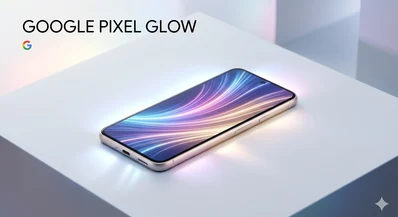
For years, the tech community has lamented the death of the notification LED—that tiny, pulsing light that told you exactly what was happening without forcing you to wake your screen. We’ve been "making do" with Always-On Displays (AOD) that drain battery and Flash Notifications that are about as subtle as a strobe light.
But according to the latest teardowns of Android 17 Beta 4, Google is finally ready to stop pretending that software can solve everything. Enter Pixel Glow.
What is Pixel Glow? (It’s Not Just a Software Skin)
Spotted in the latest build under the internal codename "Orbit," Pixel Glow is a hardware-dependent notification system designed for the upcoming Pixel 11 series. Unlike the "Flash Notifications" introduced in Android 14—which simply blinked your camera flash—the code for Pixel Glow explicitly states: "The device must have hardware lights."
This is the "smoking gun" for a major hardware shift. While recent CAD renders of the Pixel 11 haven't shown obvious LED strips, industry insiders suggest Google is integrating micro-LEDs or an RGB-conductive layer directly into the iconic camera bar or even behind a translucent "G" logo.
The Gemini Connection: AI You Can See
Where Pixel Glow moves past being a mere "Nothing Phone" clone is its deep integration with Gemini. The Beta 4 strings indicate that the light system isn’t just for missed calls; it’s a visual feedback loop for Google’s AI.
When you trigger Gemini, the back of the device will likely mirror the "rainbow" animation we currently see on-screen. For power users, this allows for hands-free AI interaction—you’ll know Gemini is listening, processing, or has finished a task just by the ambient glow reflecting off your desk. It turns the phone from a flat slab into a reactive, ambient assistant.
Market Analysis: Why Now?
The timing of Pixel Glow isn't accidental. Nothing has proven there is a massive appetite for "intentional tech"—devices that allow you to stay connected without being sucked into the infinite scroll. By placing lights on the back, Google is encouraging a "face-down" culture.
As a Lead Experience Engineer would tell you, this is about Cognitive Load Management. If you can distinguish a Slack ping from a family member’s call via a subtle green or blue "glow" on your desk, you’re less likely to pick up the phone and get lost in a 20-minute Instagram rabbit hole.
The Verdict: A Hardware Identity for the AI Era
Google has spent the last three years making the Pixel the "smartest" phone through Tensor and software. With Pixel Glow, they are finally giving that intelligence a physical manifestation. If the leaked "ic_laptop_light" icon is any indication, this isn't just a phone feature—it’s the start of a new design language for a rumored Pixel Laptop as well.
If you’ve been waiting for a reason to care about the Pixel 11 beyond another incremental camera bump, Pixel Glow is it.