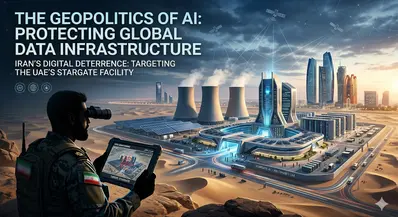
In a dramatic shift from traditional military posturing, the Islamic Revolutionary Guard Corps (IRGC) has recently directed its attention toward the digital horizon. A newly released video from the IRGC-linked sources has issued a pointed threat against the "Stargate" project—a massive $30 billion AI data center initiative currently under development in Abu Dhabi.
This isn’t just about bricks and mortar; it represents a strategic pivot. By threatening high-value Western-backed technology assets in the Gulf, Tehran is signaling that the infrastructure powering the future of artificial intelligence is now a front-line target in regional power struggles.
The Strategic Value of Stargate
Stargate is not your average server farm. Backed by a powerhouse coalition including OpenAI, Nvidia, SoftBank, and Microsoft, the project is designed to be a 1-gigawatt (GW) computing titan. Announced as a cornerstone of the Trump administration's "US AI Dominance" vision, it is set to become the largest AI deployment outside the United States.
For the UAE, the project is a central pillar of its goal to lead the global AI sector by 2031. However, this same prestige makes it a lightning rod for geopolitical friction. The IRGC's video utilized satellite imagery to pinpoint the facility's desert location, accompanied by a stark warning: "Nothing is hidden from our sight."
A New Era of Asymmetric Targeting
The threat appears to be a direct response to U.S. rhetoric regarding Iran’s own energy and power infrastructure. By specifically naming companies with American shareholders—Oracle, Cisco, and Goldman Sachs among them—the IRGC is treating these private tech investments as extensions of Western state power.
We are seeing a shift where data centers are no longer viewed merely as commercial utilities but as strategic national assets. The "Stargate" facility, with its 1GW power requirement and cutting-edge Blackwell chips from Nvidia, represents more than just compute power; it represents the intellectual and economic edge of the West.
Security and the Global Supply Chain
The implications for the tech industry are profound. As AI infrastructure expands into the Middle East to take advantage of available energy and capital, the "security of the stack" must now include physical and geopolitical risk assessments.
- Digital Sovereignty: Nations must weigh the benefits of hosting global AI hubs against the risk of becoming a proxy battlefield.
- Infrastructure Resilience: The threat against Stargate highlights the vulnerability of the massive energy grids required to keep AI models running.
- Investment Risks: With trillions of dollars in play, the tech sector's growth in the Gulf is now inextricably linked to the stability of U.S.-Iran relations.
As we move toward a world where AI is the primary driver of economic growth, the "Stargate" incident serves as a wake-up call. The race for AI supremacy is no longer confined to Silicon Valley labs—it is playing out on the global stage, where data is the new oil, and the refineries are increasingly under fire.