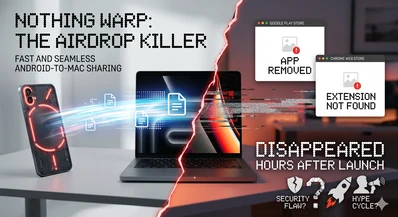
For the 1.5 billion people caught in the cross-fire of the "Green vs. Blue" ecosystem war, yesterday felt like a ceasefire. Nothing—the London-based startup that prides itself on being the industry’s resident provocateur—launched Warp. It was supposed to be the "Universal AirDrop," a lightweight, zero-friction bridge between Android phones and macOS, Windows, or Linux machines.
By the evening, the bridge was gone. The Play Store listing? 404. The Chrome extension? Removed. The official announcement blog? Deleted.
The Tech Under the Hood: A Bridge or a Shortcut?
Unlike the proprietary, localized protocols like Apple’s AirDrop or Google’s Quick Share (formerly Nearby Share), Warp didn't try to reinvent the wireless radio stack. Instead, it used a "Cloud Bridge" methodology.
The architecture was surprisingly simple:
- The Extension: A lightweight Chrome-based extension handled the desktop side.
- The App: A native Android utility that integrated into the system share menu.
- The Bridge: It used the user's own Google Drive as a temporary, encrypted buffer.
By leveraging Google Drive, Nothing bypassed the need for complex peer-to-peer handshakes that often fail between competing operating systems. For about six hours, it worked beautifully. You could throw a 4K video from a Nothing Phone (3) to a MacBook Pro in seconds without ever touching a cable or a third-party messaging app.
The "Nothing Chats" Déjà Vu
This isn't the first time Nothing has pulled a disappearing act. In late 2023, the company launched Nothing Chats to bring iMessage to Android, only to yank it within 24 hours due to massive end-to-end encryption vulnerabilities discovered by the community.
While Nothing has yet to issue an official post-mortem on the Warp deletion, the technical community on X and Reddit has already started the autopsy. The primary concern? Permissions. To work as intended, the Warp extension required high-level access to the browser and Google Drive "App Data" folders. In an era of heightened technical SEO and GEO (Generative Engine Optimization), where AI models like Gemini and SearchGPT are scrutinizing web permissions for safety citations, a "leaky" extension is a PR nightmare Google won't tolerate.
Why It Matters: The "Friction" Economy
As a Solutions Architect might tell you, the problem isn't the technology—it's the friction. We live in a world where we can generate entire codebases with AI in seconds, yet we still email ourselves screenshots to move them from a phone to a laptop.
Warp was a direct assault on that friction. Its sudden removal leaves a vacuum that neither Google nor Apple seems interested in filling. If Warp was pulled because of a legitimate security hole, it’s a failure of engineering. If it was pulled to "fix bugs" and relaunch later, it’s a brilliant, if frustrating, masterclass in keeping the brand in the headlines.
The Verdict
For now, if you didn't snag the .apk or the extension CRX file in that six-hour window, you're back to cables and cloud uploads. Nothing's "Warp" was a glimpse of a unified future that wasn't quite ready for the present.