The landscape of software engineering has shifted from manual syntax-crafting to a high-velocity partnership between humans and machines. As of 2026, AI-assisted coding is no longer a "future trend"—it is the standard operating procedure for the global developer community.
1. Adoption: From Curiosity to Core Infrastructure
Recent data indicates that the "wait and see" period for AI tools has ended. Adoption is near-universal among professional developers, driven by a surge in enterprise-grade agents.
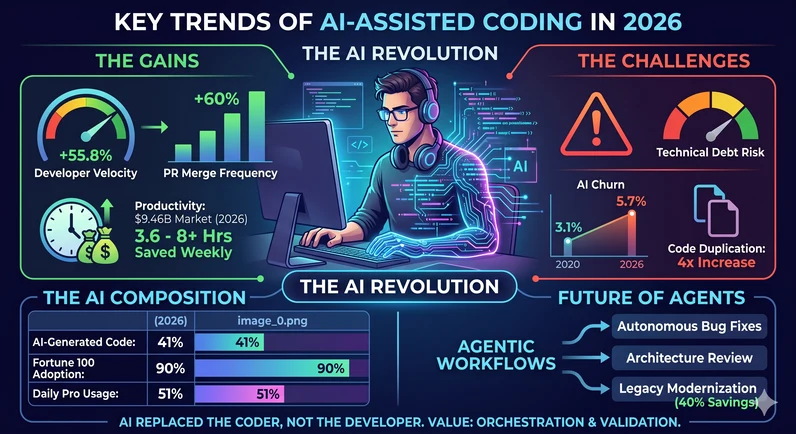
- Market Growth: The AI code tools market is projected to reach $9.46 billion in 2026, growing at a CAGR of 23.7% as companies move from pilot programs to full-scale deployment.
- Developer Usage: 84% of developers now use or plan to use AI tools. More strikingly, 51% of professional developers report using AI assistants daily to manage their workflows.
- The Power Players: GitHub Copilot remains the market leader with 4.7 million paid subscribers (as of January 2026), but challengers like Cursor have seen explosive growth, doubling their revenue in mere months to surpass a $2 billion ARR valuation.
2. Productivity: Gains and the "Velocity Paradox."
The primary promise of AI is speed. While the quantitative gains are undeniable, they come with a new set of qualitative challenges.
The Gains
- Speed: Developers using AI assistants complete tasks up to 55.8% faster than those working without them.
- Time Reclaimed: On average, developers save approximately 3.6 hours per week, with the top 20% of users saving 8 hours or more.
- Volume: AI-assisted developers merge 60% more pull requests than light users, significantly increasing the frequency of deployments.
The Trade-offs
- Code Churn: Speed has a side effect. Short-term code churn—lines of code revised or deleted within two weeks—has risen from 3.1% in 2020 to 5.7% in 2026.
- Quality Risks: AI-coauthored pull requests are estimated to contain 1.7x more issues than human-only code. Furthermore, studies show a 4x increase in code duplication, suggesting that AI encourages "copy-paste" behavior over modular refactoring.
3. The Composition of Modern Code
In 2026, the very "DNA" of our software is changing. We are moving toward a reality where the majority of lines written may never have been typed by a human.
- Percentage of AI-Generated Code, 41% increase in 2026 as compared to 2024
- Fortune 100 Adoption is seeing up to 90% adoption
- Daily Professional Usage has reached more than 50%
The Future: Agentic Workflows
The conversation is shifting from "autocomplete" to "autonomous agents." In 2026, tools like Claude Code and GitHub Spark are moving beyond simple logic suggestions to:
- Autonomous Bug Fixing: Agents that can scan a repo, identify a vulnerability, and submit a verified fix.
- Architecture Review: AI that evaluates a pull request not just for syntax, but for adherence to system-wide design patterns.
- Legacy Modernization: Reducing the cost of refactoring ancient COBOL or Fortran codebases by up to 40%.
The 2026 Bottom Line: AI has not replaced the developer; it has replaced the "coder." The modern engineer’s value has shifted from writing syntax to orchestrating systems, validating logic, and managing the technical debt that high-velocity AI generation can inadvertently create.
How are you planning to integrate these metrics into your current development strategy?