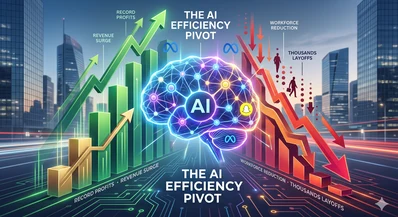
For those of us in the trenches of software architecture, the news cycles of 2024 and 2025 felt like a correction. But the reports surfacing this week regarding Meta’s 8,000-person cut and Snap’s 1,000-person layoff suggest that we aren't looking at a temporary slump. We are witnessing a permanent architectural shift.
The "Year of Efficiency" wasn't a one-off event. It was a pilot program for a future where human headcount is no longer the primary metric of a company’s scaling power.
The Meta Autopsy: The May 20 Deadline
Internal memos at Meta indicate that the next round of layoffs is slated for May 20, 2026. This isn't a broad-brush cut; it’s a surgical removal of "middle-layer" management and traditional frontend roles.
Mark Zuckerberg has been clear about Meta’s pivot to "Llama-centric" operations. For a Lead Experience Engineer or Solutions Architect, the writing is on the wall: if your role involves managing the friction between departments rather than building the core AI infrastructure, your position is being scrutinized. Meta is betting that Agentic Workflows—AI systems that can self-debug, write documentation, and manage pull requests—can replace the need for massive human coordination layers.
Snap’s Struggle: The Cost of Being a "Small" Giant
Snap’s situation is more precarious. While Meta is cutting from a position of record-breaking stock prices, Snap’s 1,000-person layoff is a defensive move. Despite their early lead in Augmented Reality (AR) and My AI, the company is struggling to keep pace with the massive compute costs required to compete with the likes of OpenAI and Google.
The fallout at Snap highlights a growing divide in tech: you are either an AI Provider or an AI Consumer. Companies that aren't building the foundational models are finding that their margins are being eaten alive by the cost of "renting" intelligence.
The "Human-in-the-Loop" Fallacy
For years, the industry narrative was that AI would simply "augment" workers, making them more productive. In 2026, the data shows a different trend. At the SDE2 and SDE3 levels, we are seeing a "collapsing of the middle."
When one senior architect using OpenAI Codex 5.0 or Perplexity’s new Agentic OS can do the work that previously required a team of five, the business logic for maintaining large teams disappears. This isn't just a cost-cutting measure; it's a realization that smaller, highly technical teams are more agile in a GenAI-first world.
Market Impact: What This Means for India and Silicon Valley
The ripples of these layoffs will be felt most acutely in global tech hubs like Bangalore and Hyderabad. As Meta and Snap reduce their "coordination" staff, the demand for traditional outsourcing models is drying up. The focus has shifted overnight to High-Agency Engineers—people who don't just write code but understand how to deploy and manage the AI agents that now write it for them.
The Verdict: Adapt or Be Automated
The fallout from Meta and Snap isn't a sign that tech is dying; it’s a sign that tech is maturing. The "Fat Tech" era of 2010–2022 is over. We are entering the "Lean AI" era, where the most valuable asset isn't a large team, but a robust architecture and a handful of engineers who know how to wield the new tools.
For those left behind, the message is "raw and unfiltered": The skills that got you here won't keep you here. It’s time to move up the stack.