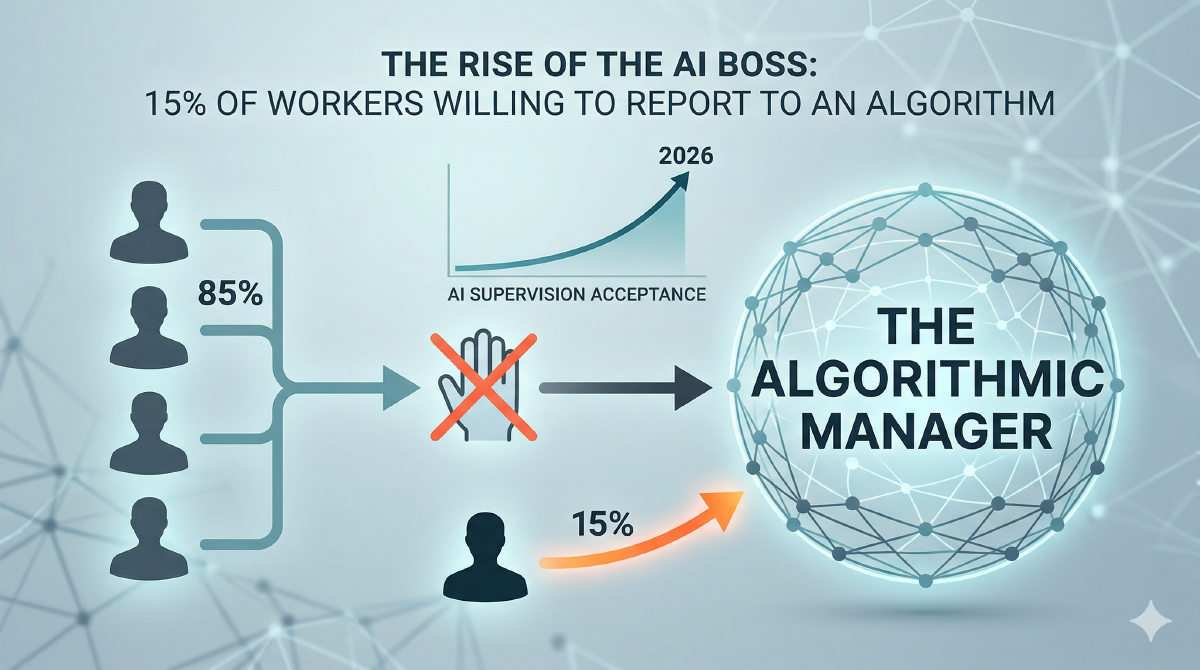
In the corporate world, the "middle manager" has long been a fixture of the organizational chart. But as generative AI transitions from a productivity tool to a decision-making entity, the very definition of leadership is undergoing a radical stress test. A fresh national poll from Quinnipiac University, released March 30, 2026, has captured a pivotal moment in this evolution: 15% of Americans are now willing to report directly to an artificial intelligence.
While a 15% "buy-in" rate might seem modest, in the context of institutional change, it represents a significant early-adopter cohort—roughly tens of millions of workers who are prepared to trade human intuition for algorithmic efficiency.
The Rise of the "Company of One"
We are entering an era that analysts call "The Great Flattening." This isn't just about streamlining workflows; it’s about the structural removal of management layers. We’re already seeing the precursors:
- Workday has deployed AI agents that autonomously audit and approve employee expenses, removing a traditional "boss" approval step.
- Amazon has integrated sophisticated AI-driven workflows that handle task allocation and scheduling—tasks once reserved for floor supervisors.
- Uber engineers have even benchmarked a chatbot version of CEO Dara Khosrowshahi to vet internal pitches before they ever reach a human executive.
This trend suggests a future where the "Manager" is no longer a person, but a protocol.
Efficiency vs. Empathy: The Great Divide
The Quinnipiac data, which surveyed 1,397 U.S. adults, highlights a complex psychological landscape. For the 15% open to an AI boss, the draw is often the promise of objectivity. An algorithm doesn't have "favorites," it doesn't suffer from Monday morning irritability, and it provides 24/7 availability for task guidance.
However, the remaining 85% remain staunchly skeptical. The primary friction point isn't just technology; it’s the "humanity gap." Critics and workers alike argue that AI lacks the capacity for nuanced mentorship, ethical advocacy, and the emotional intelligence required to manage a crisis.
The Anxiety Metric
Perhaps more telling than the willingness to work under AI is the fear of being replaced by it. The poll found that 70% of respondents believe AI will lead to an overall decrease in job opportunities. Among currently employed Americans, 30% are actively worried that their specific roles are on the verge of obsolescence.
This creates a paradox for C-suite leaders: the very tools meant to drive efficiency are simultaneously eroding the psychological safety of the workforce.
Editor’s Take: The Structural Shift
As a tech editor who has watched "digital transformation" cycles for decades, I see this as more than just another software update. The move toward algorithmic management is a fundamental rewriting of the social contract at work.
When your supervisor is a program, the workplace becomes a data-driven meritocracy—but one that risks becoming a "cold, machine-driven environment," as 20% of workers in related studies have already warned. For founders and CHROs, the challenge isn't just "deploying" AI; it’s ensuring that as the hierarchy flattens, the human element isn't crushed in the process.
The "AI Boss" is no longer science fiction. It’s an HR reality that is 15% of the way to becoming the new normal.