NEW DELHI - In an era where our wrists have become secondary smartphone screens, Google is making a bold, regressive move and it’s exactly what the market needs.
Today’s official launch of the Fitbit Air marks a pivot away from the smartwatch trend, leaning instead towards a more compact version of technology .
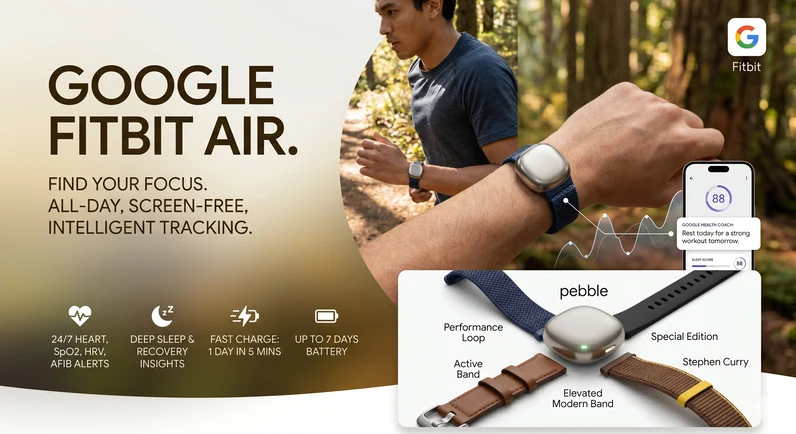
Priced at a competitive $99 (approx. ₹8,499 in India), the Fitbit Air is a screenless, pebble like tracker that sits flush against the skin. It’s not trying to replace your phone, instead trying to disappear into your life.
The "Less is More" Engineering
The most striking feature of the Fitbit Air is, ironically, what it lacks: a display. By removing the power-hungry OLED panels, Google has achieved a staggering 14-days battery life in a chassis that is approximately 40% thinner than previous models.
But don’t let the minimalist exterior fool you. Under the hood, the Fitbit Air is packed with Google’s latest sensor suite:
- Continuous cEDA: Tracking microscopic sweat responses to map stress levels in real-time.
- Advanced Heart Rate Variability (HRV): Optimized for recovery tracking, a favorite for the growing community of "biohackers" in cities like Bengaluru and Mumbai.
- SpO2 & Temperature Sensing: Tracking blood oxygen levels and skin temperature variations to provide a holistic view of your recovery.
- Advanced Sleep Tracking: Features a new Sleep Score model and "Smart Wake" haptic alarms to wake you during your lightest sleep phase.
Why India is the Primary Battleground
While the global tech press focuses on the quirky design, the business logic behind the Fitbit Air is clearly aimed at the Indian market. At the ₹8,000 - ₹9,000 price point, the Air occupies the "Goldilocks Zone"—it’s more premium than budget bands from local players, yet far more accessible than the Apple Watch or even Google’s own Pixel Watch.
For the Indian consumer, the value proposition is two-fold: Reliability and Style. With the rise of "quiet luxury" and a move away from flashy tech, a tracker that looks like a premium bracelet but functions like a medical-grade monitor is a winning formula.
Furthermore, the 14-day battery life solves the pain point of charging a device every single night - a major deterrent for consistent health tracking.
The Senior Editor’s Verdict
As someone who has spent the last decade reviewing "smart" everything, the Fitbit Air feels like a breath of fresh air. We’ve reached peak screen fatigue. The constant haptic buzzing of notifications on our wrists has moved from helpful to intrusive.
By stripping away the UI, Google is forcing the user to focus on the only thing that matters: the data. The Air doesn't want you to look at it; it wants you to look at your Fitbit Premium dashboard once a day and understand your body’s trends.
It is a specialized tool for a specific kind of person—one who values their focus as much as their fitness. If Google can maintain the software support for this device, which it can as we all know, the Fitbit Air might just be the most influential wearable of 2026.