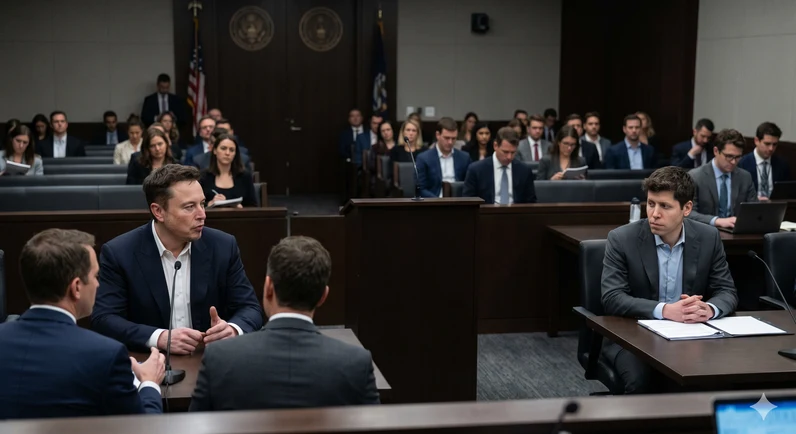
OAKLAND — The most consequential courtroom drama in the history of Silicon Valley officially moved from legal filings to the federal stage this morning. In a high-security courtroom at the Dellums Federal Building, jury selection began for Musk v. OpenAI, a trial that serves as an existential audit of the most powerful technology on Earth.
While the legal technicality centers on "breach of charitable trust" and "unjust enrichment," the subtext is a Shakespearean saga of ego, betrayal, and the control of Artificial General Intelligence (AGI). Elon Musk, who provided the early capital and the philosophical scaffolding for OpenAI in 2015, is asking the court to dismantle the current for-profit structure that has turned Sam Altman’s firm into a trillion-dollar powerhouse.
The "Long Con" Allegation
Musk’s legal team, led by a cadre of top-tier litigators, wasted no time framing the narrative. Their argument is centered on a "Founding Agreement"—a set of principles Musk claims were used to induce his $44 million in donations. These principles mandated that OpenAI remains a non-profit, open-source laboratory dedicated to developing AI safely for the public good.
"This was not an investment; it was a mission," the prosecution stated in early filings. Musk’s side contends that Altman and OpenAI President Greg Brockman executed a "long con," using Musk’s credibility and capital to build a tech titan, only to pivot toward a closed-source, profit-driven model once the technology became viable.
OpenAI’s Defense: Evolution, Not Betrayal
Across the aisle, Sam Altman and the OpenAI legal team have dismissed the lawsuit as a case of "founder’s remorse." They argue that the sheer scale of compute power required to reach AGI made the original non-profit vision financially impossible.
The defense is expected to present evidence that Musk himself advocated for a for-profit shift as early as 2017—on the condition that he would have full control. OpenAI’s central argument is simple: The mission to benefit humanity is still intact, but the method to achieve it had to evolve. They maintain that the partnership with Microsoft was a tactical necessity, not a breach of trust.
The Microsoft Factor: A Loosening Grip?
In a move that many industry insiders believe was timed to blunt the impact of this trial, Microsoft and OpenAI recently amended their partnership terms. The updated deal reportedly gives OpenAI more freedom to sell its technology to third parties and reduces Microsoft’s exclusive hosting rights.
However, Musk’s team is unlikely to be appeased. They are focused on the "AGI Clause" in the original Microsoft contract—a provision that stipulates Microsoft loses access to OpenAI’s intellectual property once the company achieves a "human-level" system. A major component of this trial will be a legal debate over whether current models, such as GPT-5 or the rumored "Q*" project, already constitute AGI.
Why the Industry is Watching
Beyond the personal friction between Musk and Altman, the verdict from Judge Yvonne Gonzalez Rogers could set a precedent that ripples across the entire tech ecosystem.
- The Definition of AGI: For the first time, a court may be forced to legally define when a machine reaches "human-level" intelligence.
- Non-Profit Governance: The trial challenges the legality of "capped-profit" structures, potentially exposing other "tech-philanthropy" hybrids to similar lawsuits.
- Public Access: If the court finds in favor of Musk, it could force OpenAI to open-source its frontier models, a move that would fundamentally shift the competitive landscape of the AI industry.
The Unfiltered Perspective
As the trial moves into opening statements, one thing is clear: This isn't just about money. Musk has already stated that any damages awarded—potentially exceeding $130 billion—should be funneled back into the non-profit arm of OpenAI, not his own pocket.
This is a battle for the soul of the industry. It asks if a company can truly be "open" while being the engine of a multi-billion dollar for-profit enterprise. As we track the testimony in Oakland over the coming weeks, we will finally see if Silicon Valley’s "move fast and break things" culture can withstand the scrutiny of federal law.