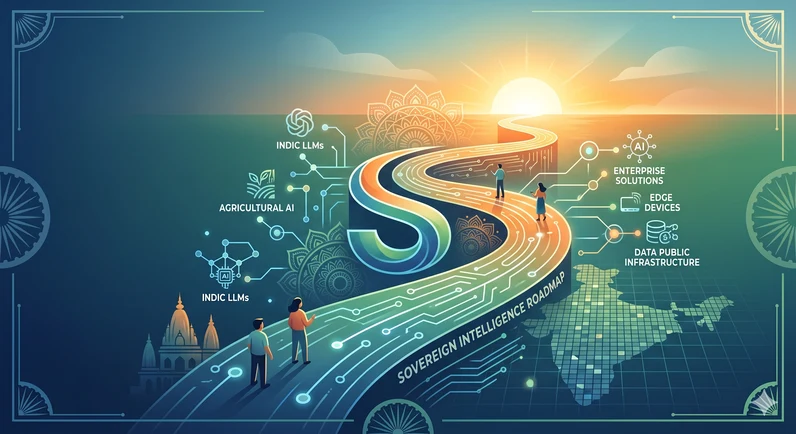
The global narrative surrounding Artificial Intelligence often borders on the utopian, driven by the massive capital expenditures and relentless hype cycles of Silicon Valley. However, observing the landscape from the vantage point of 2026, the reality of India’s AI trajectory is far more nuanced. While the initial wave of generative AI was characterized by unbridled enthusiasm, the current phase demands a grounded, pragmatic assessment of what it actually takes to build indigenous cognitive infrastructure.
At thetodaystandard.com, our ongoing analyses of tech policy highlight that true digital sovereignty cannot simply be imported via API keys. It requires foundational builders who understand the subcontinent’s unique linguistic and infrastructural bottlenecks. Leading this localized revolution are startups like Sarvam AI, Krutrim, and KissanAI. Yet, their respective journeys underscore a sobering reality: building artificial intelligence for a billion people involves navigating immense data scarcity, compute deficits, and complex socio-political impacts.
Sarvam AI: The Architects of Public-Spirited Intelligence
Founded in 2023 by Dr. Vivek Raghavan and Dr. Pratyush Kumar, Sarvam AI represents a profound departure from the typical venture-capital-driven software startup. The foundational ethos of Sarvam is deeply rooted in India's digital public infrastructure (DPI). Dr. Raghavan’s decade-long experience architecting Aadhaar’s biometric backbone, combined with Dr. Kumar’s pioneering research at AI4Bharat (IIT Madras), established a clear mandate: to create models natively fluent in India's vast linguistic diversity.
In February 2026, Sarvam made a significant technological leap by open-sourcing two major foundational models: Sarvam-30B and the highly sophisticated Sarvam-105B. Utilizing a Mixture-of-Experts (MoE) architecture, Sarvam-105B selectively activates approximately 9 billion parameters per token, making enterprise-grade reasoning computationally viable without requiring exorbitant hardware [1].
Furthermore, their selection by the Ministry of Electronics and Information Technology (MeitY) to spearhead the IndiaAI Mission's sovereign model initiative cements their role in public service delivery. To catalyze the broader ecosystem, the company launched the Sarvam Startup Program in March 2026, offering crucial API credits and engineering support to early-stage builders. However, despite securing a robust $41 million Series A early on, the scale of resources required to maintain parity with Western frontier models remains a daunting challenge. Total Indian AI funding in 2025 hovered around $1.34 billion—a fraction of global mega-rounds. Sarvam's approach is therefore necessarily resourceful, focusing on architectural efficiency and hyper-local contextualization rather than sheer brute-force compute.
Broadening the Ecosystem: Krutrim and KissanAI
Sarvam does not exist in a vacuum. The broader Indian AI ecosystem is rapidly diversifying, encompassing both horizontal foundational platforms and highly specialized vertical applications.
Krutrim AI Labs, propelled by Bhavish Aggarwal, swiftly achieved unicorn status by attempting to build a vertically integrated AI ecosystem. Over the past couple of years, they have aggressively rolled out an array of multimodal solutions, including the Krutrim-1 large language model, Chitrarth for vision-language tasks, and Dhwani for speech [2]. Their strategic release of advanced Indic Optical Character Recognition (OCR) models is aimed at digitizing decades of physical government and corporate records. Their ambition even extends to designing indigenous silicon to reduce dependency on foreign hardware. Yet, the industry consensus remains cautiously observant; the leap from model announcements to seamless, hallucination-free enterprise integration requires rigorous, continuous refinement.
Contrasting this generalized approach is KissanAI, a prime example of vertical AI delivering immediate, tangible value. Founded by Pratik Desai, KissanAI bypasses the race for artificial general intelligence (AGI) or Agentic AI to focus entirely on the agricultural sector. Operating as an AI-powered advisory system, it provides millions of farmers with hyper-local insights on pest management, irrigation, and market pricing in their native dialects [3]. By allowing a farmer with a basic smartphone to interact via voice and receive immediate, actionable advice, KissanAI exemplifies the democratization of knowledge. It proves that the highest ROI in the Indian AI space often comes from solving deep, domain-specific bottlenecks.
Navigating the Societal Impact
As we integrate these models into the fabric of daily public life, we must deliberately shift our analytical focus. The conversation around indigenous technology often gets trapped in superficial organizational critiques of Western tech monopolies and their market dominance. The far more urgent dialogue centers on analyzing the societal impact of deploying large-scale conversational AI in a diverse democracy.
Language models are inherently reflective of their training data. If indigenous foundational systems are not rigorously aligned and governed, they risk becoming automated engines for ideological propaganda, subtly amplifying false narratives and skewing public perception at an unprecedented scale. Building "Made in India" AI is not just an exercise in economic self-reliance; it is a critical safeguard against the mass distribution of polarized rhetoric. The ultimate success of these AI platforms will not solely be measured by their parameter counts, but by their ability to foster genuine, objective social awareness and rethink historical biases encoded within regional digital content.
The "Data Scarcity" Wall and the Path Forward
The most sobering hurdle for the 2026 Indian AI ecosystem is what experts call the "Data Scarcity Wall." While India boasts massive digital penetration, the volume of high-quality, cleanly annotated digital text in regional languages—such as Odia, Assamese, or rural dialects of Hindi—pales in comparison to English. Global models attempt to bypass this by translating English thoughts into Indian languages, inevitably losing deep cultural nuance.
Startups are being forced to innovate around this bottleneck. The immediate future relies heavily on developing sophisticated pipelines for generating high-fidelity synthetic data to fill these linguistic voids. Initiatives like the government-backed Bhashini project are crucial, but bridging this gap requires sustained capital and unprecedented collaboration between academia, the private sector, and policymakers.
Hope for Sustainable Growth
The indigenous AI perspective in 2026 is less about utopian disruption and more about infrastructural resilience. The realistic hope for growth lies not in defeating global tech giants at their own game, but in redefining the rules of engagement. By prioritizing voice-first interfaces, hyper-local context, and domain-specific utility—from automated administrative grading to agricultural pest detection—India's AI startups are laying the groundwork for a highly inclusive digital economy.
The collective journey of Sarvam, Krutrim, and KissanAI proves that sovereign intelligence is technologically achievable. However, realizing its full national potential will require unwavering commitments to ethical deployment, continuous infrastructural investment, and a pragmatic understanding that the hardest, most vital work is still ahead of us.
References
[1] Fortune India, "Sarvam AI launches 30B and 105B models tailored for India-focused deployment," February 2026.
[2] Krutrim AI Labs, "India’s Frontier AI Research & Milestones," 2024-2025.
[3] AI Startup Impact, "KissanAI — AI agricultural advisory for Indian farmers," 2026.